
I Reached Hacker Rank by Building an Operator, Not by Grinding Boxes
Twenty-nine days ago I had never owned a machine on Hack The Box. In a month I hit Hacker rank. In the same window of time, I received an email from Anthropic that told me my account had been approved for their Cybersecurity Verification Program, and that the default safeguards blocking dual-use offensive-security work had been lifted for my organization.
Two milestones, one stretch of time. The interesting thing is what they say together, and how I earned the Hacker rank.
The Rank Is Not the Story
In January of 2021 I joined Hack The Box. Back then you had to hack your own invitation, you couldn’t just sign up. It took me around four hours to do so, and I was so happy when I succeeded. I love problem solving and have always leaned into things that challenge me. Up until June of 2026, I had only completed Tier 0 and Tier 1 of the Starting Point machines. On May 26th of this year I started back up on Hack The Box and achieved Hacker rank by the second week of June. I did not grind these boxes the way I would have done five years ago, with a terminal, a notebook, and my own two hands doing every step. I built an operator, called it Harkonnen, and connected it to HTB through their API. Over the last five years I have built up a collection of over 50 cybersecurity books that I purchased through Fanatical and Humble Bundle. As I mentioned in previous posts, I converted all this knowledge to markdowns and used them to build skills, tooling, and scripts. I wanted to prove out my theory that arming an AI harness with a specific body of knowledge and pointing it at a specific target could achieve good results. This idea is similar to my work with my Oracle HCM body of knowledge. My local AI harness reasons about a target, selects and chains its own tooling, and drives multi-stage attack paths while I supervise the decisions that carry risk.
The harness runs a six-phase method on every engagement: observe the target, think through the attack surface, plan the path, execute, verify the result, and record what it learned. Recon feeds foothold. Foothold feeds privilege escalation. Each stage writes its own notes, so the next stage starts from evidence instead of from scratch. I orchestrated the flow. The system did the repetitive reach.
Harkonnen Learns as It Goes
The body of knowledge was the starting point, not the finish line. The part I care about most is what happens after the box is done.
At the end of every session Harkonnen captures what it just learned. Not a log dump, a review: what worked on this machine, what wasted time, what pattern is worth keeping. From that review it writes new knowledge into its own store, and when a technique is repeatable it turns that technique into a skill, a script, or a piece of tooling it can reach for next time. The failure that cost me time tonight becomes a checked step tomorrow. The system is editing itself to be faster than it was an hour ago.
That is the difference between a tool and a system that compounds. A tool does the same thing every time you run it. Harkonnen does not run the same way twice, because every engagement leaves it with more skills, tighter tooling, and knowledge it did not have before. I did not have to teach it the second machine the way I taught it the first. It taught itself the parts it had already seen.
The learning does not stay on my disk. Harkonnen saves its knowledge to a GitHub repo and opens pull requests against it, so every gain is versioned, reviewable, and permanent. I read the PR, I see exactly what it decided to remember and why, and I merge it. The improvement is not a black box I have to trust. It is a diff I can read.
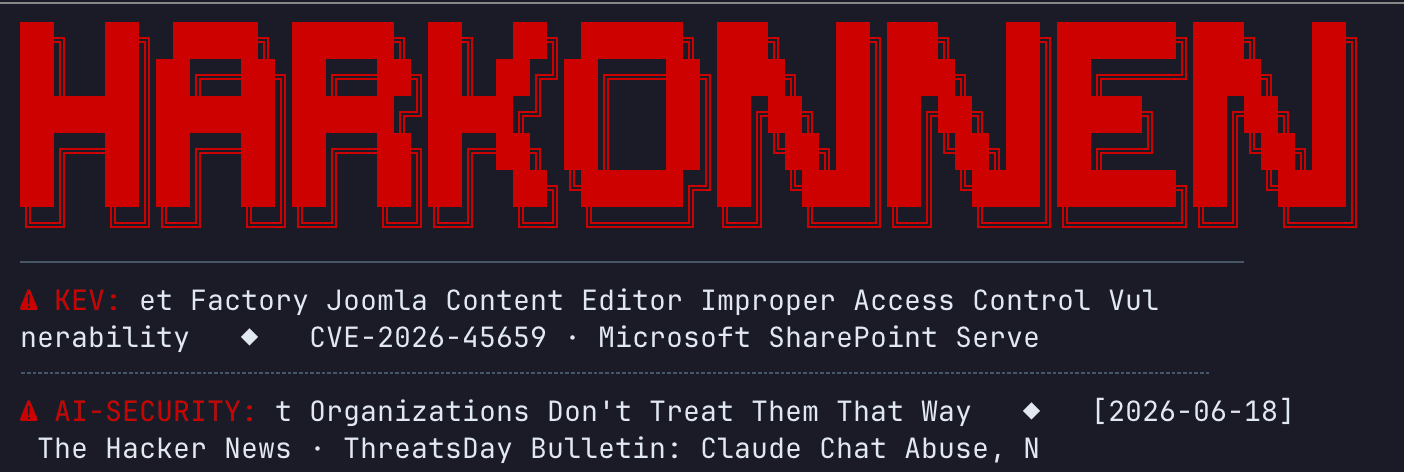
Not all of what Harkonnen knows comes from the boxes. I built a live intelligence feed into it, a KEV and AI-security news aggregator that pulls from trusted sources: CISA’s Known Exploited Vulnerabilities catalog and a curated set of AI-security outlets. The point is that Harkonnen is not learning from a snapshot frozen the day I fed it 50 books. It sees what is being exploited in the wild this week, and it sees what is happening to AI systems specifically, because the systems it defends and attacks are increasingly AI systems themselves.
The Skill Moved
For a long time the scarce skill in offensive security was memorization. Know the exploit, know the flag, know the one misconfiguration that opens the machine. The person who had walked the most paths was the winner.
That is now changing. When a system can hold the technique, the scarce skill becomes something else: designing the harness that wields the technique, setting the boundaries it operates inside, and knowing exactly which decision the human keeps. Which is systems engineering and security research in the same job.
This is not a tool that replaces the operator. It is a tool that raises what one operator can direct. The exploit knowledge still matters, the same way arithmetic still matters after the calculator. It just stops being the bottleneck.
Why the Anthropic Approval Belongs in the Same Post
Building an autonomous offensive-security operator runs straight into a wall by design. Frontier models are shipped with safeguards that block exactly this class of work, because most people asking a model to write an exploit are not authorized to. That is the correct default.
The Cybersecurity Verification Program is how a legitimate operator gets past that default the right way. I described my use cases. Anthropic reviewed them, verified I am a real security practitioner doing authorized work, and lifted the dual-use safeguards for my account. Vulnerability exploitation and offensive tooling are no longer blocked by default for my organization.
So the two milestones are not a coincidence stacked next to each other. They are two sides of the same claim. Hack The Box measured the capability by results. Anthropic verified the operator by review. One is proof the system works. The other is proof I am trusted to point it.
Where This Goes
Security work is moving from “an expert runs the tools” to “an expert directs a system that runs the tools.” The autonomous piece is coming whether the industry is ready or not. The open question is who is trusted to point these systems, and who understands where the rails have to be.
That is the seat I have been building toward, and now I have evidence on both sides of it. The capability, verified by a rank earned in under a month. The operator, verified by the vendor building the frontier.
The tools are getting autonomous. The scarce skill is knowing where to put the human. That part was never the model’s job to figure out. It is mine.