
The Loop Is the Skill
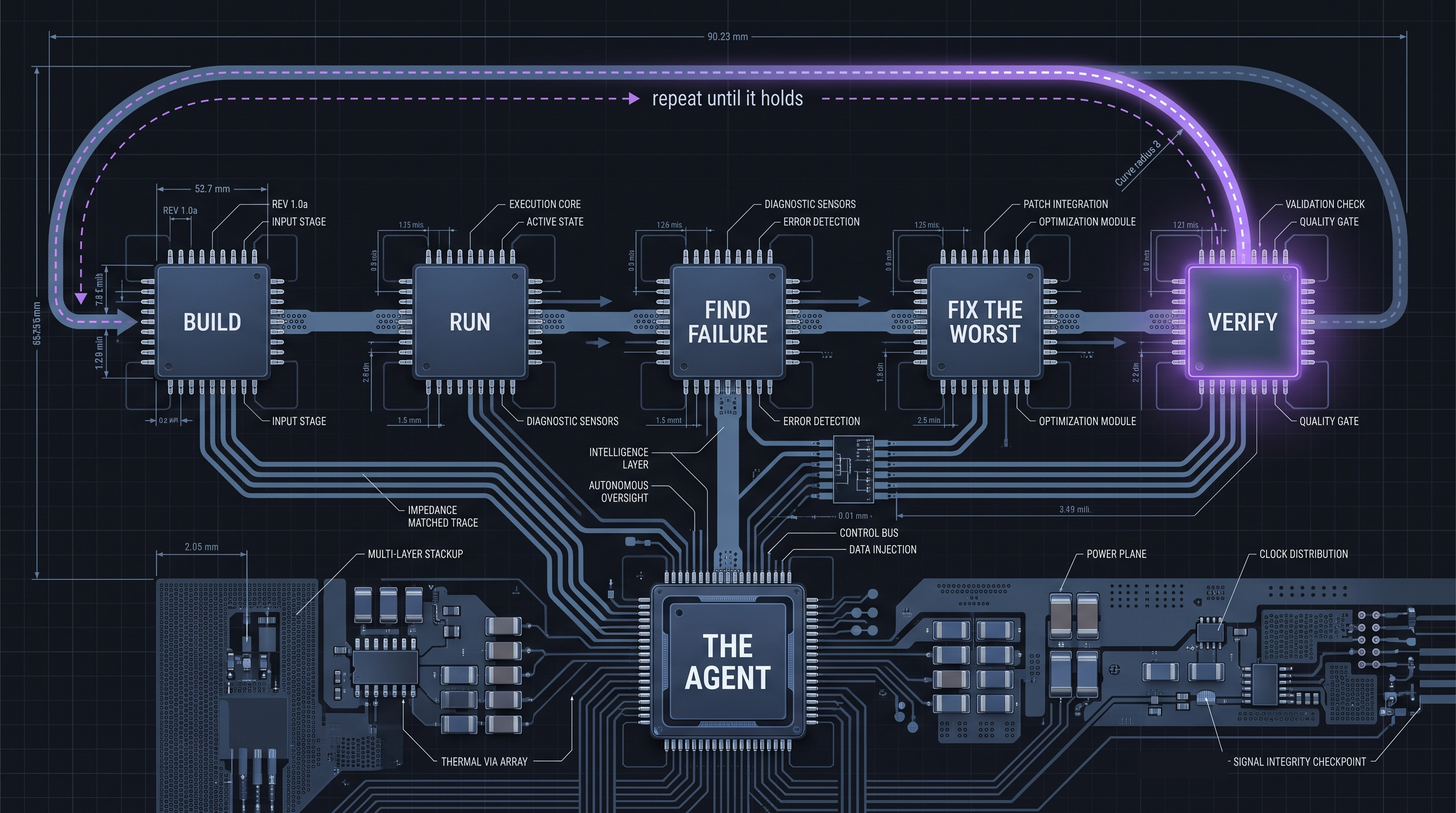
As I was going through the deeplearning.ai Agentic AI course, Andrew Ng put a loop on the screen: build a quick prototype, run it, look at where it actually fails, fix the component that is failing most, and repeat. He called it the disciplined development process for agentic systems.
If you are learning to build AI infrastructure, that loop is the thing to learn first. Not a framework, not a model, not a clever prompt. The loop. Everything else is detail you hang off it once it is running.
What follows is what the course taught me about that loop, in the order I would teach it to someone starting out. I will be honest about one thing as I go, I had already been working with most of this before I took the course. These patterns are what you converge on when you build the real thing, which means you can converge on them too.
Start With the Loop, Not the Tools
Most people learning agentic AI start by collecting tools: a framework, a vector database, an agent library. That is backwards. The first skill is the development loop itself, because it is the thing that turns a demo into a system.
The loop is four moves. Build the smallest version that runs. Run it on real input. Find where it actually failed, not where you assumed it would. Fix the one component that is failing most, then run it again. You are not trying to make it perfect on the first pass. You are trying to make the next failure visible.
The reason this matters more than any tool: agentic workflows are multi-step, so errors compound. A small failure early corrupts everything downstream, and all you see at the end is a broken result with no idea where it broke. The loop is how you keep the failures local enough to fix. Skip it, and you are debugging a black box.
So before you reach for anything else, build the habit of running the loop. It is cheap, it is unglamorous, and it is most of the job.
Error Analysis Is Where the Work Lives
Here is the move inside the loop that beginners skip: you do not improve an agentic system by staring at the final output and guessing.
Andrew is relentless about this. When a multi-step system produces a bad result, the instinct is to tweak the final prompt until the output looks better. That is polishing the part you can see while the real break sits three steps upstream. The discipline is error analysis: trace each failure back to the component that caused it, find the bottleneck, and spend your effort there instead of on the part that was already fine.
This is a posture, not a tool. You are training yourself to ask “which component failed” before you ask “how do I make the output nicer.” Once you have that habit, the loop has somewhere to point. Without it, you are just rerunning the prototype and hoping.
When working with the PAI system, this is the principle I had reached on my own, from the trust side rather than the measurement side. The system does not get to say work is finished. It has to demonstrate it, with evidence captured the moment the claim is made. “Should work” is not an answer it is allowed to give. Same refusal, two directions: Andrew refuses to believe an unverified result because guessing does not improve a system, and I refuse to believe one because an unverified claim is worthless to the person depending on it.
Evals Turn Guessing Into Measuring
The deepest thing the course teaches is not a pattern. It is that you cannot improve what you do not measure.
An eval is just a repeatable test of whether your system did the right thing. Once you have one, the loop stops being vibes. You change a component, you run the eval, and you know whether it got better or worse instead of guessing from one impressive-looking output. The build-run-fix loop and error analysis tell you where to spend effort. Evals tell you whether the effort worked.
This is the part that feels like overhead when you start and turns out to be the whole game. A demo that works once proves nothing. A system you can trust is one where every fix is measured and every past failure stays measured. That is the difference between something that demos well and something you can run in front of real users at volume.
The Three Moves Most Beginners May Have Not Reached Yet
The course pointed at three practices that go beyond a basic verify-it-ran loop. If you are learning, these are the next things to build, in order.
The first is the agent judge. Verifying that work is correct is not the same as judging whether it is good. A deliverable can pass every technical check and still be the wrong thing to hand to whoever asked for it. The fix is a second agent whose only job is to evaluate the first one’s output against a standard, and running a few of them with different lenses so one agent’s blind spot does not become the system’s. Verification asks “is this true.” A judge asks “is this good.”
The second is adversarial verification. It is one thing to confirm a finding. It is another to actively try to break it. A separate agent, prompted to refute rather than agree, catches the plausible-but-wrong conclusion that a confirming pass waves through. The finding survives only if the skeptic cannot knock it down.
The third is the one everyone underrates: evaluation that accumulates. A system that checks its work and then forgets cannot tell you whether it is getting better or quietly getting worse. The fix is a test set that grows, where every real failure becomes a permanent check that runs on every future change. You cannot improve what you do not measure, and you cannot measure what you throw away after each task.
None of this is complicated. This is the difference between a system that produces work and one you can trust at volume.
Build the Loop Before You Build the Agent
So if there is one thing to take from all of this, it is the order. You do not need permission to build the real thing, and you do not need to wait for a course or a certificate to hand you the patterns. Nobody is keeping them behind a gate. Prototype, watch where it actually fails, fix the part that fails most, verify, repeat. You learn that loop by running it. The reason these principles read as familiar to me is that I had already hit them on real work before the course put names to them. That is what it feels like when you learn something the right way: the words arrive after the understanding, not before.
Start with the cheapest discipline that works. The discipline was never supposed to live in the model. Make your AI write down what it is about to do, then make it prove it did it. That single habit is most of the work. Then, once the loop is running, get serious about evals, because measuring whether the system is actually getting better is what separates a demo from something you can trust.
Build the loop first. The agent is what you build on top of the loop.