
Your AI Isn’t Going Off the Rails. It Never Had Any.
Your AI Isn’t Going Off the Rails. It Never Had Any.
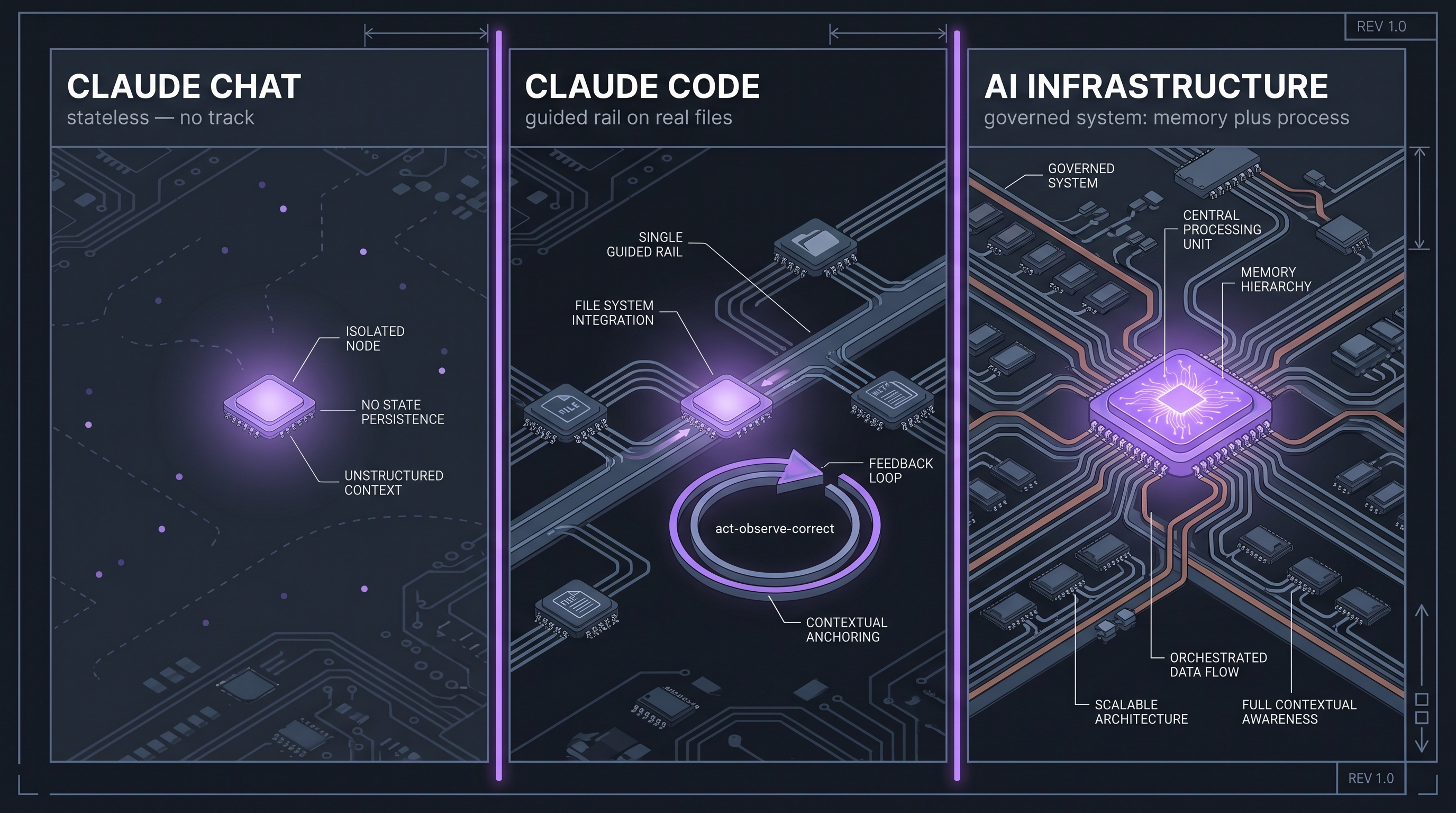
The most common complaint I hear from people using AI is some version of the same sentence: “It goes off the rails.” It drifts. It forgets what I told it. It invents things. It has no direction.
I understand the frustration, but the phrasing hides the actual problem. Going off the rails implies there were rails to begin with. There weren’t. A model in a blank chat window has no memory of who you are, no rules about how it should behave, and no defined process for doing the work. It is not drifting away from a plan. There was never a plan for it to drift from.
So when people tell me their AI lacks direction, what they are really describing is a missing system. The fix is almost never a better prompt. It is more structure. And the amount of structure you give the AI is the single biggest variable in whether it behaves like a reliable partner or a clever stranger who resets every morning.
The clearest way I have found to explain this is as three tiers. Each one solves a bigger slice of the “no direction” problem than the last.
Tier 1: Claude Chat — The Conversation
This is where almost everyone starts, and where most people stay. You open a chat window, you type, it responds. Each conversation is mostly a blank slate.
The defining trait of this tier is amnesia. A new chat forgets everything. Whatever context you want the model to have, you provide manually, in the prompt, every single time. The direction comes entirely from you. The model cannot touch your files, run anything, or reach your systems. It talks, and that is all it does.
This is genuinely useful. For a quick question, a brainstorm, a first draft, or thinking out loud, a chat window is fast and frictionless. But it is also exactly why it feels directionless on anything bigger. Nothing constrains it. There are no rules, no persistent goal beyond your last message. If your prompt is vague, the output is vague. It is a brilliant intern with total amnesia, and you are re-explaining the entire job every morning.
People at this tier blame the model. The model is rarely the issue. The issue is that nothing is holding it on a track, because there is no track.
Tier 2: Claude Code — The Operator
The second tier is a different kind of tool entirely. Claude Code is an agent that lives in your terminal. It does not just talk about work — it does the work. It reads and writes real files, runs commands, searches the web, and operates on your actual environment instead of an imagined one.
Two things change the moment you move here.
First, it gets a working memory of your project. A CLAUDE.md file holds persistent instructions for that codebase or project, so the model arrives already knowing the conventions, the goals, and the rules you have written down. You stop re-explaining the project on every session.
Second, and more importantly, it works in a loop: act, observe the result, correct. It writes a file and sees whether the change worked. It runs a command and reads the actual output. That feedback loop is what kills the drift. The model is not imagining what might happen — it is looking at what did happen and adjusting. Operating on real artifacts instead of guesses is most of the discipline.
The honest limitation: this discipline is per-project and largely manual. You set up each project’s instructions yourself. The memory does not follow you from one project to the next, and there is no consistent persona or process spanning everything you do. It is a sharp, capable operator — but one you have to brief fresh for every new job.
Tier 3: AI Infrastructure
The third tier is the one that actually fixes “no direction” at the root, because it stops treating each session as a fresh start.
AI Infrastructure is a system that wraps Claude Code and gives it a permanent identity, a rule set, a knowledge base, and a defined process. The jump from Tier 2 to Tier 3 is the difference between hiring a contractor and building an operations department. This post itself is a small example: it was written inside an AI Infrastructure that already knew my blog’s voice, my formatting conventions, and where the file should be saved, without my having to say any of it.
Three things work together here, and they are what make drift structurally hard.
The first is persistent identity and memory. The infrastructure does not forget who I am, what I work on, or how I want things done. When I correct it, the correction sticks across every future session, not just the current chat. The knowledge lives in files I own, not inside a conversation that disappears when I close the tab.
The second is a defined process. Every non-trivial request gets classified and routed through a structured sequence: understand the request, plan the approach, do the work, verify it against explicit criteria. The model cannot freewheel, because a process governs the response before it starts. That is the literal opposite of going off the rails — the rails are built in.
The third is context routing. Instead of me pasting the right background into every prompt, the system pulls the relevant knowledge automatically based on what I am doing. The model arrives oriented, every time.
None of this makes the underlying model smarter. It makes the environment around the model disciplined. That is the whole trick.
The Same Symptom, Mapped to the Fix
When someone describes their AI as directionless, the specific complaint usually tells you exactly which tier they are stuck on and what would move them up.
If it forgets what you told it, you are in a chat window and you need persistent instructions — that is the move to Claude Code.
If it hallucinates instead of using your real data, you need to let it read your actual files — again, the move to an operator that touches your environment.
If you keep re-explaining your preferences across projects, you have outgrown per-project memory and need persistent identity — the move to infrastructure.
And if it has no consistent process from one task to the next, you need a defined algorithm governing how every request gets handled — the same move.
Notice the pattern. Every one of these is solved by adding structure, not by writing a cleverer sentence into the prompt box.
The Real Shift
Direction is not something you nag the AI for inside each prompt. It is something you build into the system once.
That reframing is the entire jump from chatting to infrastructure. A chat window is equally capable on day one and day three hundred, because nothing accumulates. An operator gets more useful per project, as long as you keep briefing it. An infrastructure compounds — every rule you add, every preference it learns, every process you refine makes the next session start further ahead than the last.
If your AI feels like it has no direction, it is not malfunctioning. It is doing exactly what an unstructured system does. The rails were never the model’s job to build. They are yours.